

Air and fuel bleeds

I get a question like this fairly often:
“Hey Drew, my carb is rich at idle, should I drill out the air bleeds?”
My answer is almost always “absolutely not.”
Maybe it’s due to many modern carbs that are available with changeable bleeds, but generally speaking unless you are really deep into fine tuning, there should be no reason to change the idle or high speed, airbleeds.
I really don’t care for this new “change the airbleeds!” Fad.
If the issue is strictly at idle, it can be corrected with mixture screw adjustment. If the issue is at no load idle and also transition, maybe it makes sense to change the idle jet, or “idle feed restriction.”
Simply put, changing the Idle Feed Restriction (IFR) will change the fuel available throughout the entire range where the idle circuit is active.
The majority of the time this really isn’t required. In the scenario where you bought carbs that are designed for a race engine with a massive cam, yeah sure, that makes sense to remove some idle fuel.
Changing the airbleed however does far more than just add or subtract air, it changes the draw on the fuel bleed, so circuit timing changes as well. Obviously, if needed, this is fine, but typically I see novice tuners getting themselves into more trouble this way by their changes producing unexpected results.
Now, all of that said, I’m going to describe how to do some of this anyway, because if I’ve learned anything from the internet, talking to a person who is knowledgable is nice, but Joe on the Holley forum said he did it and it worked fine, so you are going to do it anyway.
On the flipside, I have to do this fairly often simply because Joe’s influence already caused someone to drill stuff and now I have to put it back like it was.
First things first, if we are going to do this, lets do it correctly:


Pin gauges. These are small gauges that measure the size of a hole. Yes yes, you can measure with a drill bit, but these are fairly cheap and make for repeatable inspection. Of note, many of the mini drill bits you buy are NOT the size labelled, so being able to check the hole size is critical for decent work.
I forget how much these two sets cost, but it’s fairly reasonable.
Next, the bleeds:

These are small 6-32 brass set screws. Very cheap and easy to find.

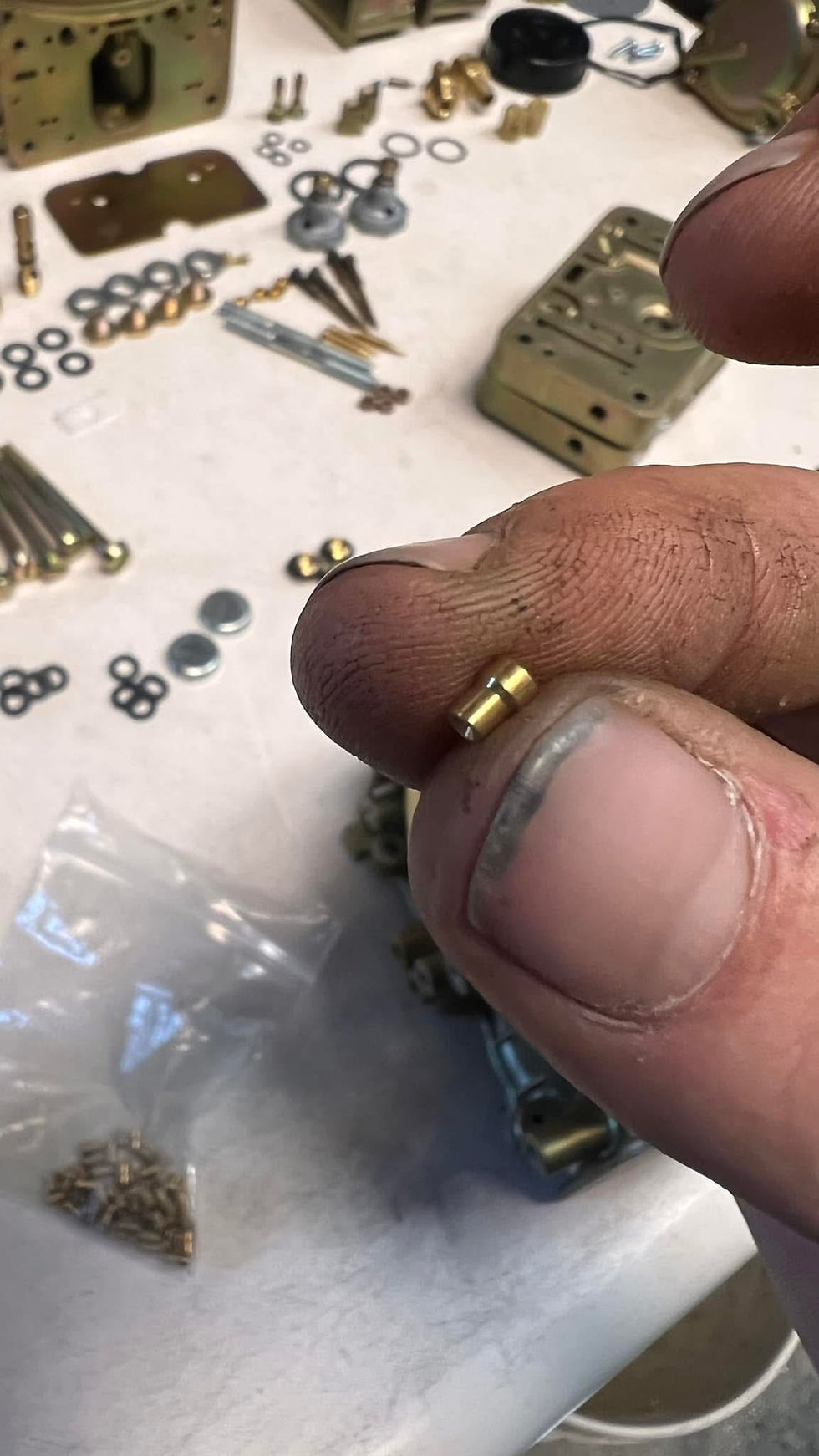
Harder to find, and less available are these press in stock style bleeds.
I buy a ton of these and they are predrilled at a small size like .016 so it makes enlarging them fairly simple.
They are however a little trickier to install so probably best to stay with threaded types.
You may find that 6-32 thread is sufficient for many high speed bleeds, 8-32 is required for the idle air bleeds, and with some newer carbs, 10-32 may be needed.
Pictured below is a carb where some well intentioned tuner way overdrilled high speed bleeds. I forget exactly but I think stock was .028 and .025, these were drilled .040 or larger.


To remove a bleed, I typically use a really sharp drill, in this case a # 35 bit. The goal here is not to drill it out, but for the sharp bit to grab and spin the bleed out. As such, it takes a bit of finesse to feel it spin while you pull up and remove the brass restriction.

At this point you want to drill your new restriction.
Many ways to do this. You obviously need to resize the hole for your press in bleed, or to drill and tap for your desired brass set screw.
I tend to count how many half turns with a tap is required and replicate that. If doing for the first time, I would tap a 6-7 half turns, test how the blank set screw sits in the hole. If too shallow, run the tap down and do a few more half turns. By counting you can make all of them the same height with ease.
A few ways to predrill your bleeds shown below:
With threaded inserts I tend to drill pilots in a plate. Often I’ll do a few hundred at a time.
My plate was made on my milling machine so all the holes are fairly straight.

I insert as many bleeds as needed and flip the plate upside down. This way you are drilling in the cup of the set screw, very nice way to have a centered hole.
I tapped this plate all the way through, so I need to clamp the plate down, otherwise I’ll just drill the screw out the other side.
You can use a small hand powered pin vise, or I use this small adapter for my hand drill. Tap magic is the preferred lube here, especially the really thin stuff meant for aluminum.

Typically I predrill these at .016 or smaller. You can obviously do them to the finished size if you wish.
Since I do so many at once, I typically like just a pilot so I can drill to finished size as needed.
Far easier for me to store a few hundred drilled with a pilot vs storing a dozen finished sizes.
You can use your handheld pin vise to drill the finished size.

If larger holes are needed or speed matters, I often chuck the restriction in my drill and hold the pin vise by hand. Any of the above work just fine.

Anyhow, that is what I do.
I didn’t have any good pictures on hand about removing the idle feeds in the metering blocks, but it is pretty much the same idea.
You can do this for power valve fuel channels.
Another handy place for this sort of thing is in the secondary metering plates for 4160 style carbs.
A very simple way to make changeable jets for these without buying special plates or floats, etc.

I will reiterate again tho, adding or subtracting fuel is pretty simple, changing air bleeds requires a lot more dedication to testing, tuning, using a wideband and paying attention to what the circuits are doing and when.
Best of luck.
Drew

Comments